

- Universal Personalizer — Universal BCI Personalization: One API for Frozen EEG Trunks and Foundation Models (Paper 1)
- Resource Ladder — When Should a Deployed BCI Decoder Spend Adaptation Resources? A Resource Ladder for Frozen Encoders (Paper 1b)
How the experiments work (data flow)
Before the numbers: this is the shared Paper 1 / 1b experimental pipeline.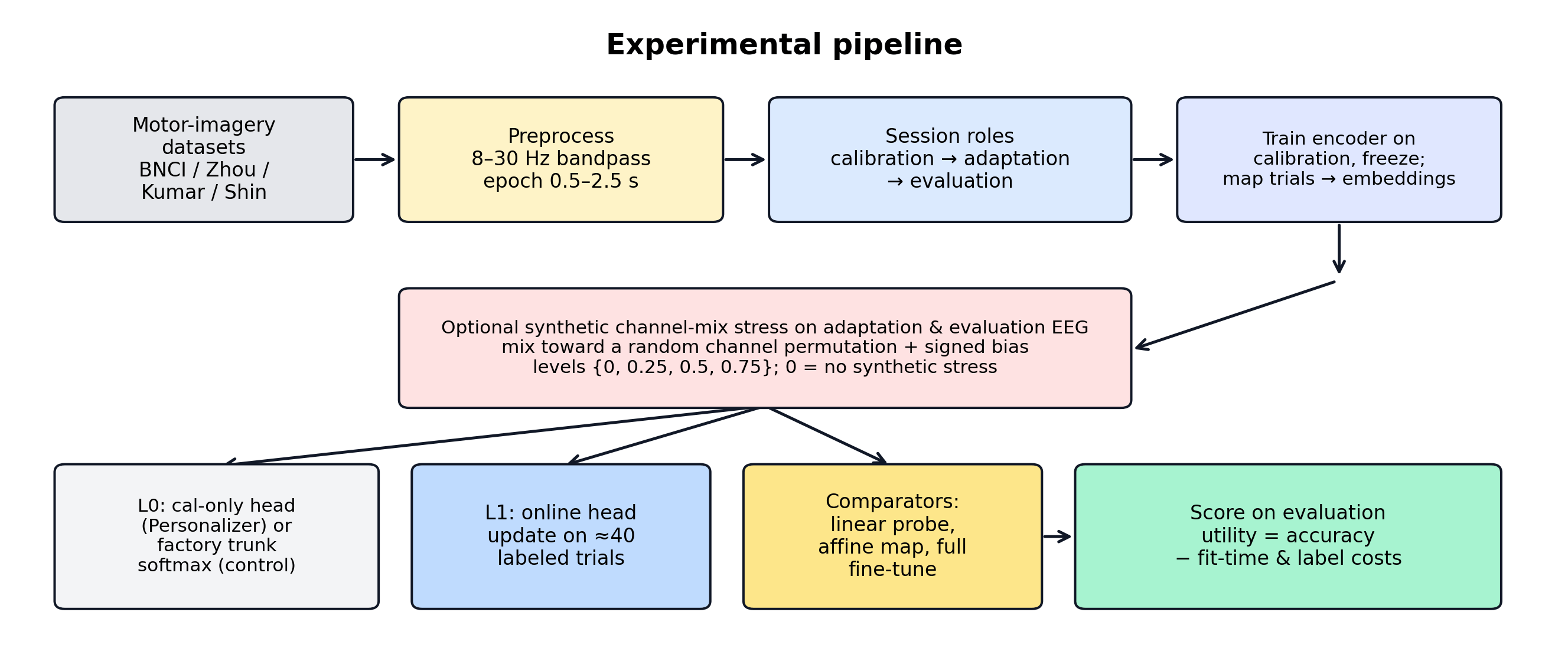
Not claimed as covered by this stress: physical electrode displacement, SNR drop, or every clinical shift type — only controlled synthetic channel mixing.
Core: L0 / Bayesian head / linear probe / full FT
Main multi-trunk accuracy–cost block (Paper 1): under the same transfer cells (severe channel-mix stress, n=40, CUDA), calibration-only Personalizer (L0), stream Personalizer (L1), a matched linear probe on the same frozen embeddings, and warm-start full fine-tune (L3).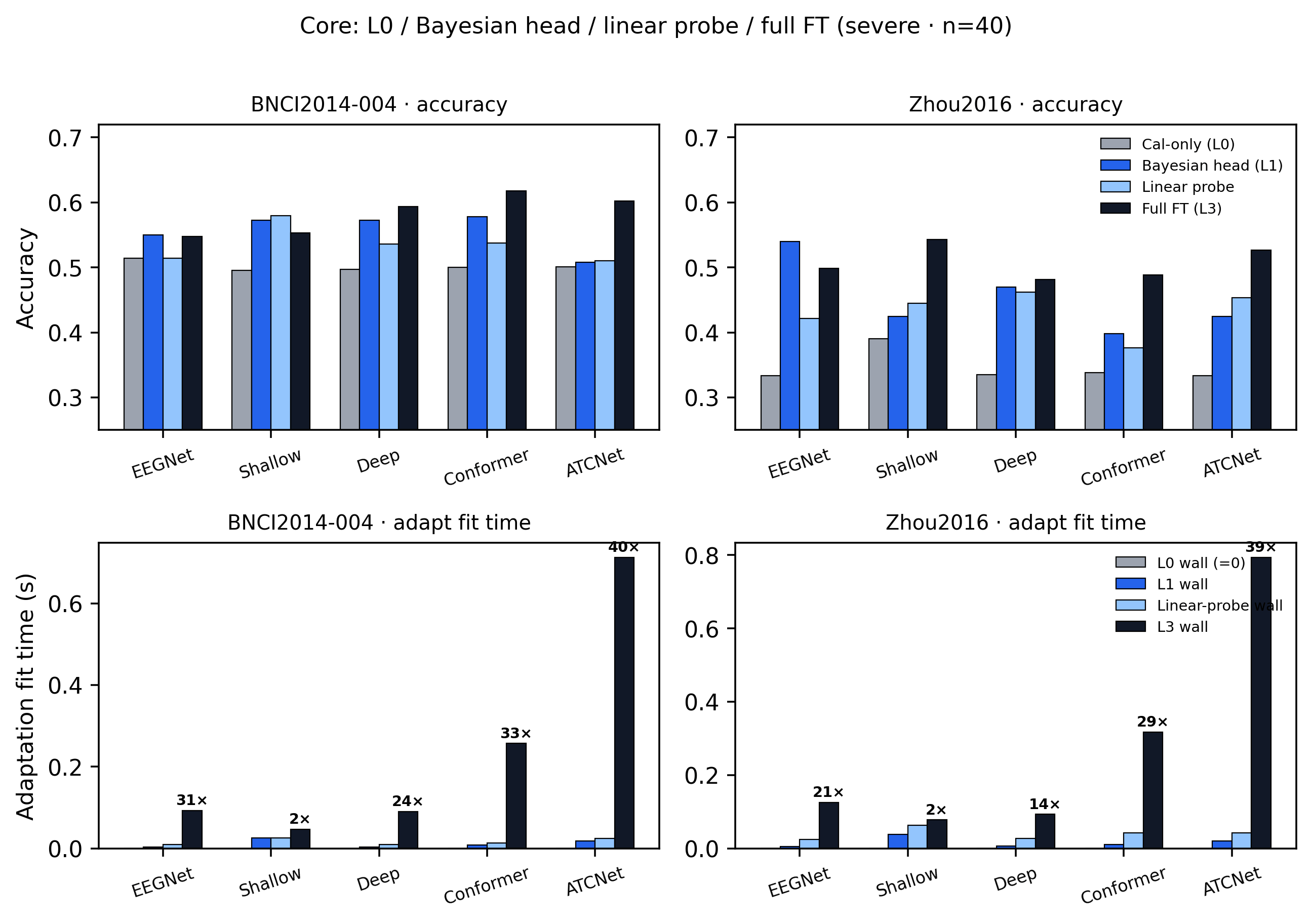
rec labels = (acc_L1 − acc_L0) / (acc_L3 − acc_L0), or “≥FT” when L1 matches or beats L3. Bottom: adapt fit wall (L0 stream wall = 0) with L3/L1 ratios.
Recovery = (acc_L1 − acc_L0) / (acc_L3 − acc_L0). On most trunks the Bayesian head recovers ~65–90% of the FT gain over cal-only and beats the matched probe (EEGNet / Deep / Conformer). Shallow and ATCNet are probe-competitive (LP can edge L1 by a few points) while both stay far below L3 wall — Personalizer remains the product default (same API + UQ /
BrainState), not a claim that L1 always wins raw accuracy. BNCI Shallow is still the Pareto win vs FT (~2× wall); ATCNet on BNCI is the hatch case (8% recovery).
Mid severity strengthens “head first”: across BNCI+Zhou subject cells, stream L1 matches or beats warm-start L3 on accuracy in about half of cells at severity 0.25 / 0.5 (~49% / ~48%) versus about a third at 0.75 (~35%). Wall L3/L1 ratios stay expensive at every severity — severe is where FT most often still buys residual pp.
Which head? (LDA vs QDA vs Softmax)
The multi-trunk map locks LDA for comparability. On the EEGNet path, Paper 1 also compares QDA and Softmax under the same bake-off geometry (severe and clean, n=40).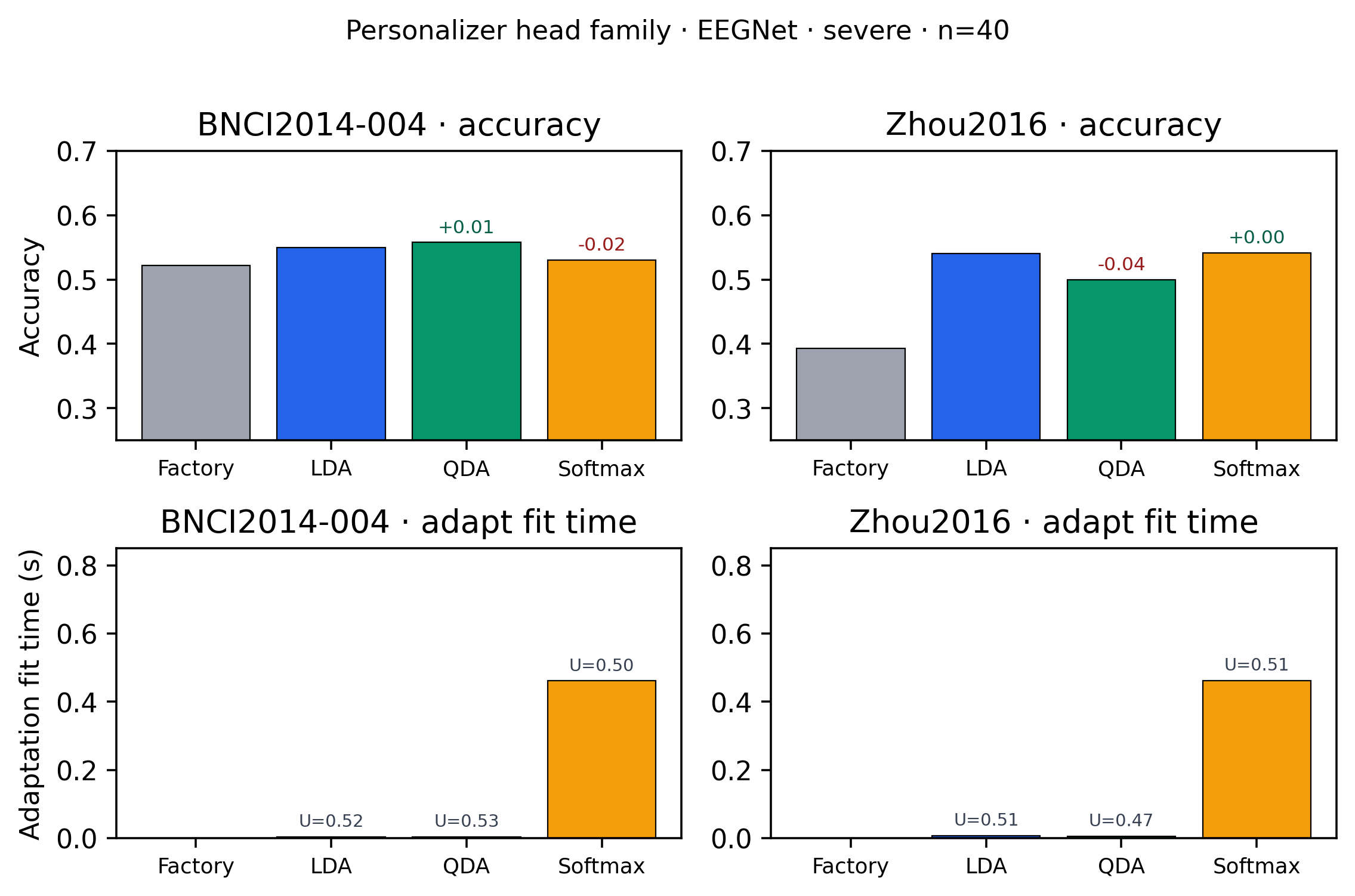
- Product default: LDA (
head="lda") — no optional dependency; locked ladder / FT narrative. - BNCI severe: QDA lifts utility (~+0.085–0.088) at essentially the same wall; Softmax gains accuracy but pays ~1.7× LDA wall.
- Zhou severe (n=4): inconclusive — QDA / Softmax at or below LDA. Clean BNCI/Zhou: heads nearly tied on U.
- Softmax stays optional (
nimbus-bci[softmax]) for UQ-oriented deployments. The 18-cell transfer map is not re-run for every head.
More evidence
Where the head helps (severity sweep + winners)
Where the head helps (severity sweep + winners)
Stream Personalizer (L1) vs calibration-only (L0) across synthetic channel-mix stress levels on an 18-cell trunk×dataset map: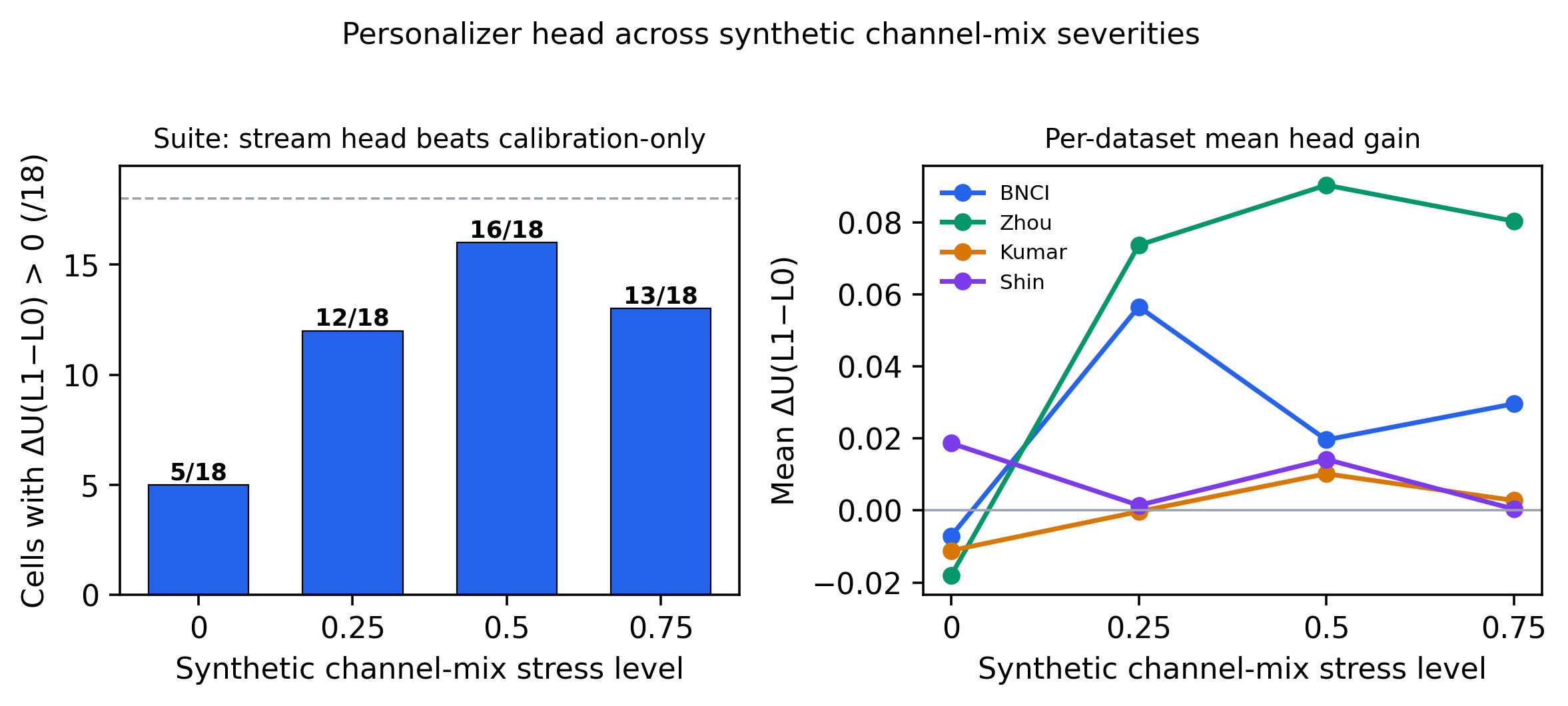
Zhou: head helps on every trunk. BNCI: often useful, not automatic (ATCNet stays L0). Kumar/Shin: boundaries — Personalizer is the default integration path, not a guarantee that L1 beats L0 everywhere.
Spotlight: EEGNet denser baselines
Spotlight: EEGNet denser baselines
Controlled bake-off on one classical reference trunk (BNCI primary, Paper 1b). Under severe shift with n=40 labeled stream trials, the Bayesian head can beat full FT on BNCI in this protocol; Zhou is the honest softer boundary.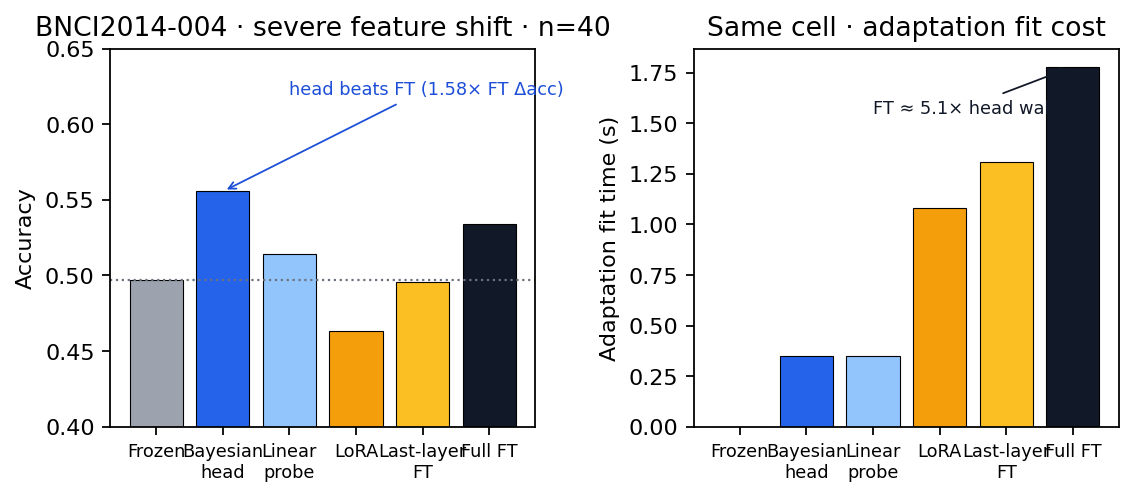
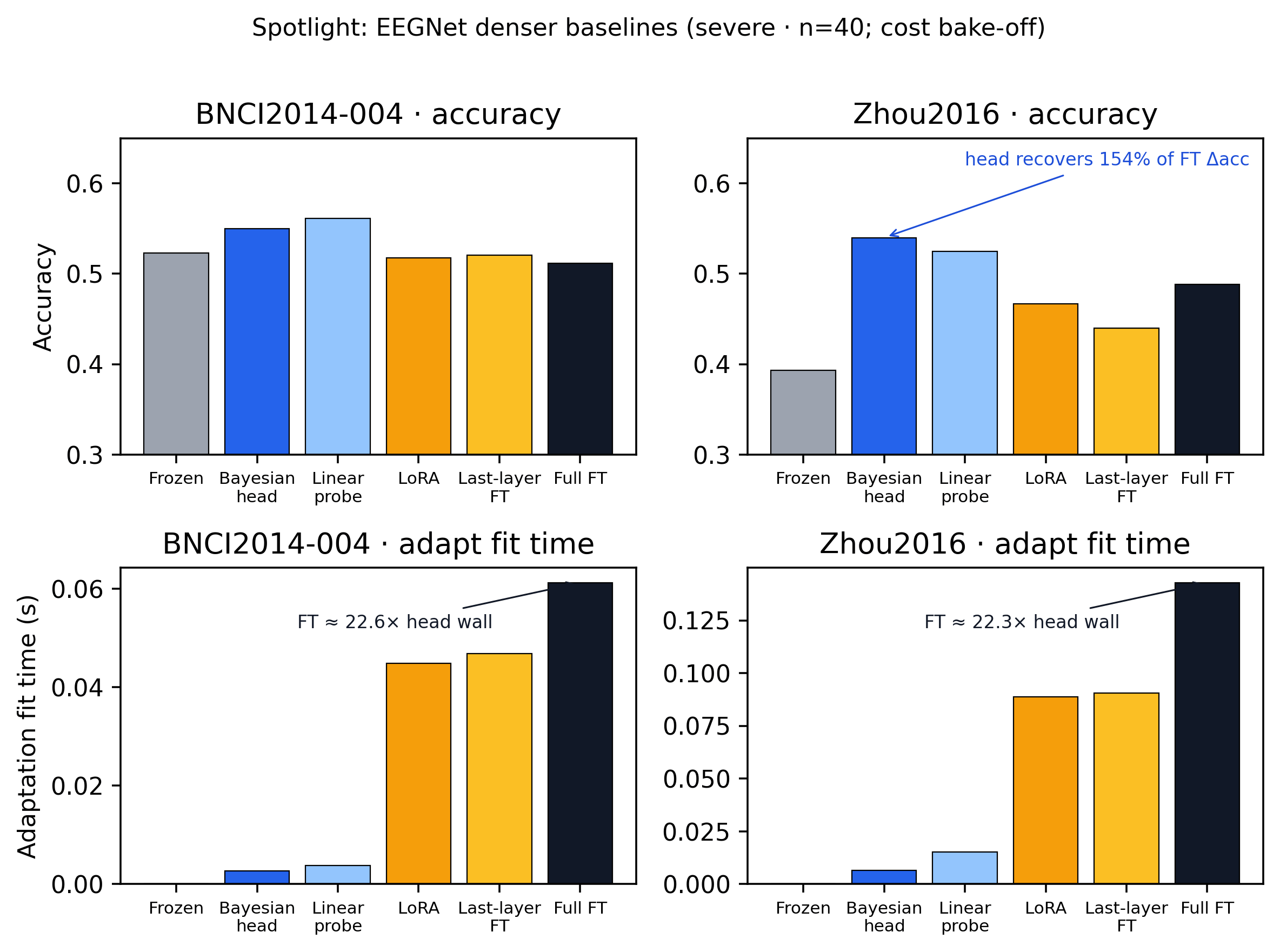
Recovery = Δacc / Δacc_fullFT (values > 1 mean the head beats FT). Treat head-beats-FT as BNCI-primary in this protocol, not a suite-wide constant. On Zhou2016 (supporting, 4 subjects): frozen 0.317 → head 0.462 → full FT 0.540 (~0.43× of FT gain at ~5.5× lower fit time).Paper 1 EEGNet arm zoo (same denser grammar; bake-off walls ~5× ≠ ladder CUDA L3/L1 ~20–30×):
Spotlight: foundation REVE
Spotlight: foundation REVE
The same Personalizer contract runs on Hub REVE. Under severe shift, adapt wall stays sub-second while last-layer / full FT cost about 20×–40× more on Zhou/Kumar.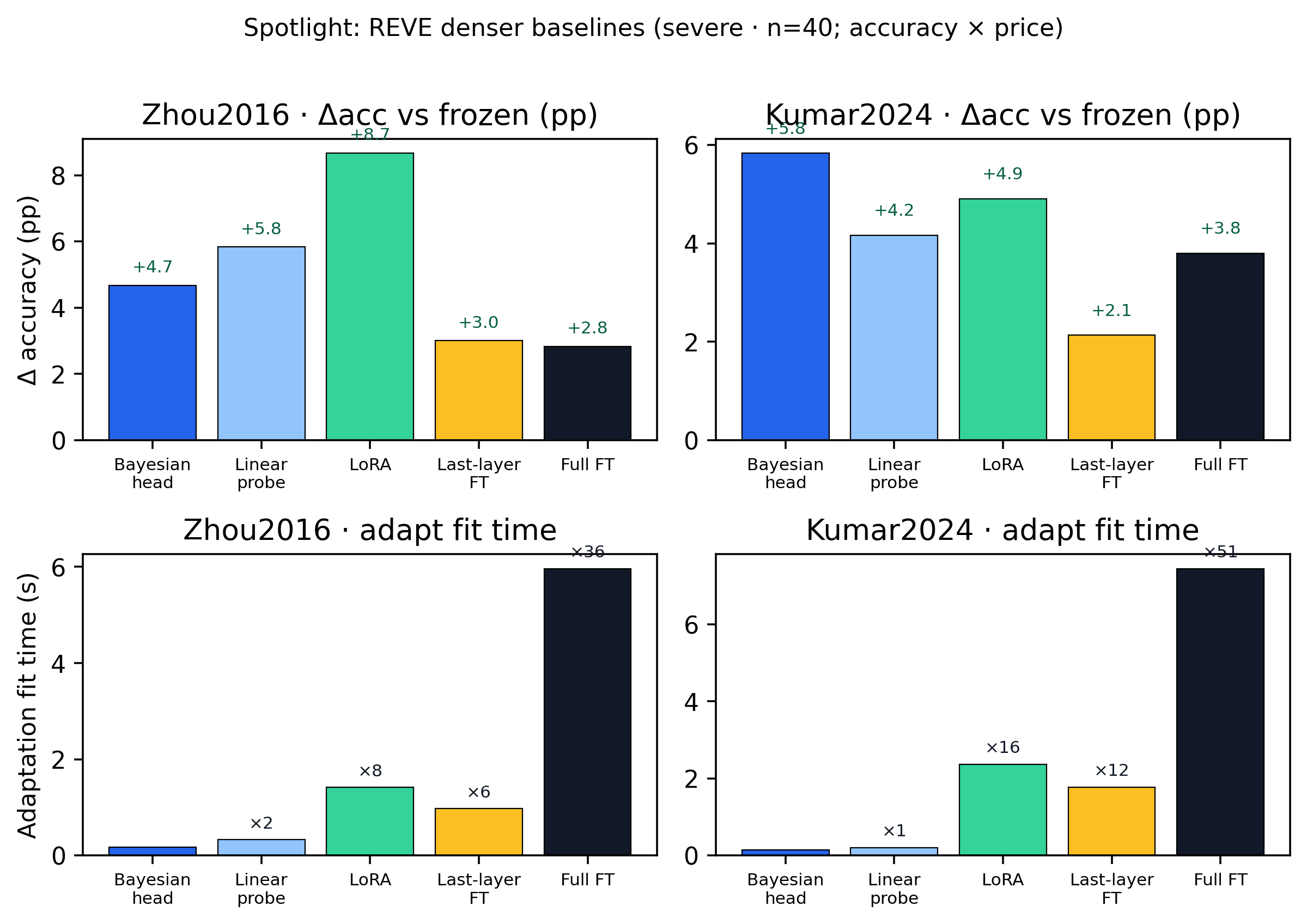
- Kumar: head Pareto-dominates short FT (+5.8 pp vs last +5.1 pp at far lower wall).
- Zhou: last-layer can buy extra pp (+13 vs head +4.7) at ~21× wall — priced purchase, not the default.
- Not claimed: frozen REVE + Personalizer matches cal-trained EEGNet absolute accuracy. BNCI REVE cost is a 3-subject smoke — not a headline.
Transfer across trunks
Transfer across trunks
Soft operational default vs strict ordinal schedule (18 cells; exploratory). “Severe → L2” means the protocol affine+head winner — in 0.6 affine is available as an opt-in 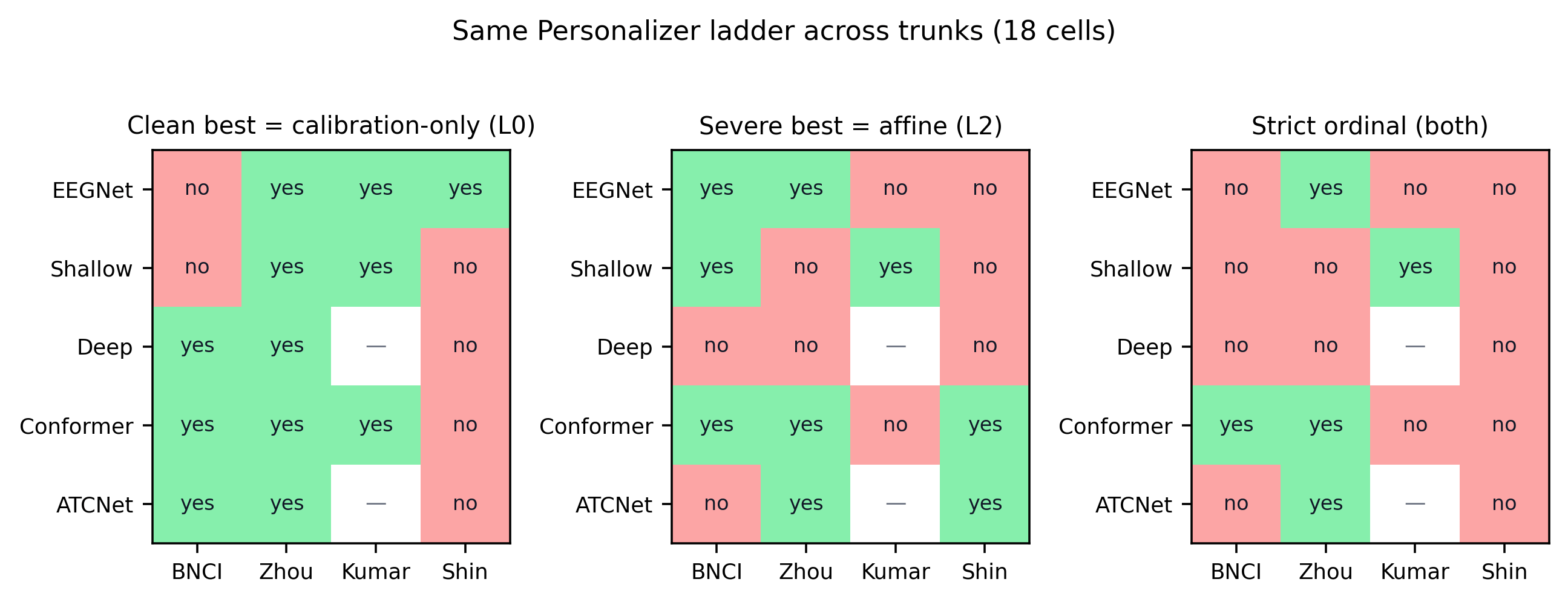
transform= / fit_affine(), not a deployment default.Product claim (honest boundaries)
Not claimed: L1 always beats L0 or LP; QDA always beats LDA; universal ordinal severity→level law; coverage of session / electrode / SNR shift (evidence is synthetic channel mixing); foundation SOTA; suite-wide 30× ratios from other protocols; shipped “Active Inference for EEG”; affine maps as a deployment default (they remain opt-in / research via
transform=).