

BrainState outputs.
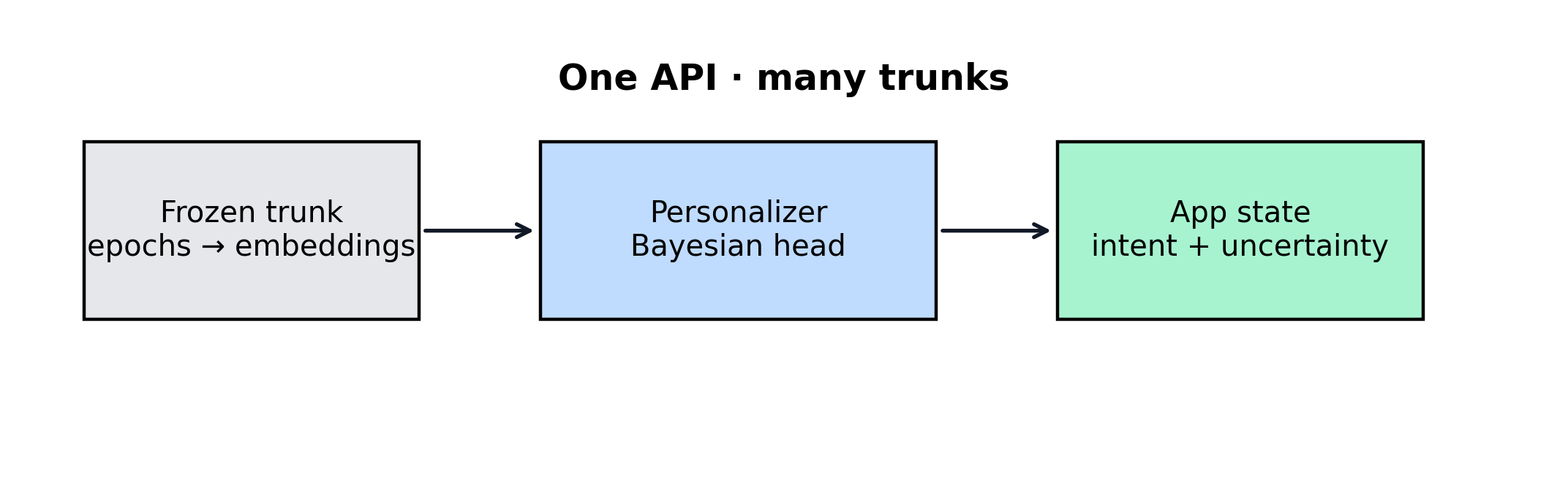
One-liner: anything that maps trials to embeddings plugs in; Nimbus owns personalization, uncertainty gating, and cheap online updates — not the trunk.
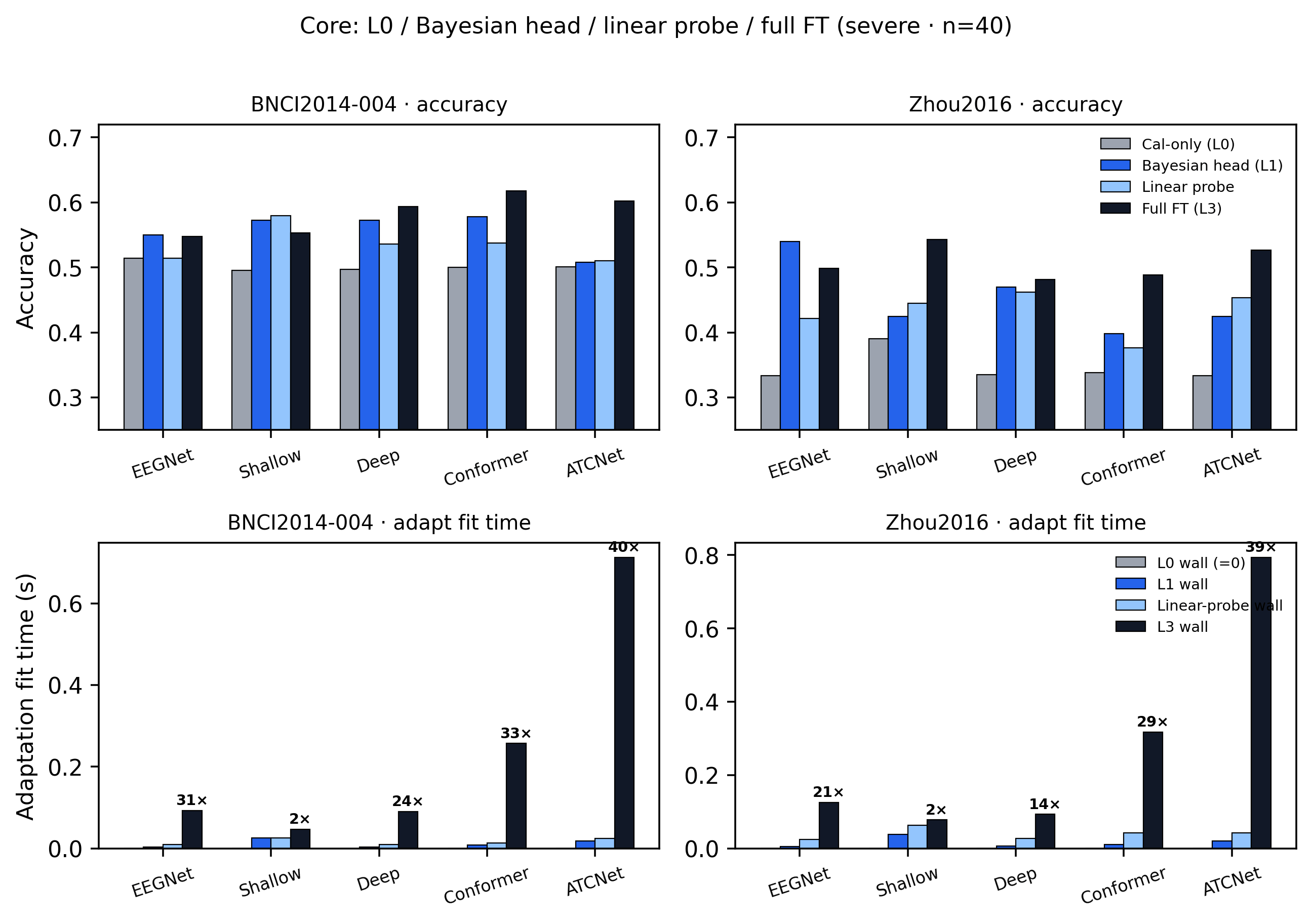
Ladder legend (plain language)
Blue
rec % on the figure = how much of the L0→L3 accuracy gain L1 recovers: (acc_L1 − acc_L0) / (acc_L3 − acc_L0). ≥FT means L1 matches or beats L3.
How the Paper 1 / 1b numbers were produced (datasets, bandpass, session split, synthetic stress): Evidence → How the experiments work.
Classical CSP / bandpower / Riemann features still work. Use
Personalizer.for_features(...) or the standalone heads (NimbusLDA, …) documented under Models. Upgrading from 0.5? See Migration to 0.6.Start here
Encoder contract
wrap → Personalizer → save/load rules.BrainState
App-facing intents, presets, and bridges.
Evidence
Head vs probe vs FT, LDA/QDA/Softmax, REVE, transfer map.
Paradigms & profiles
MI / P300 / Riemann recipes and day-2 profiles.
Transforms
Embedding-space alignment before the head.
Python Quickstart
Fit a Personalizer in a few minutes.
Minimal example
for_research (permissive + knobs), for_features (no trunk), for_riemann / for_p300 (nimbus-bci[riemann]), for_balora (nimbus-bci[train]). Paradigm recipes and day-2 profiles: Paradigms & profiles.
Integrator checklist
- When to adapt — prefer the adaptation gateway, or the thin mean-shift helper with a user-supplied threshold:
tau; full fine-tune stays a manual escape hatch. Portable day-2 warm-start: export_profile() → from_profile(...). See Evidence.
-
Trial gate (different signal) —
preset="strict"/"permissive"(0.6 rename; wasresearch/consumer); inspectBrainState.rejected,need_more_data,uncertainty. See BrainState. -
Head stability — after online updates, use
calibration_sufficient/calibration_statuson an unlabeled pool. -
Encoder swap — freeze trunk; match
embedding_dim; never pass logits as embeddings; keepmodel_idconsistent acrosssave/load/ profiles. See Encoder contract.
Next read
Encoder contract
Wrap rules and save/load.
BrainState
App-facing intents and presets.
API Reference
Personalizer and middleware symbols.
Heads / Models
LDA, QDA, Softmax, STS.